
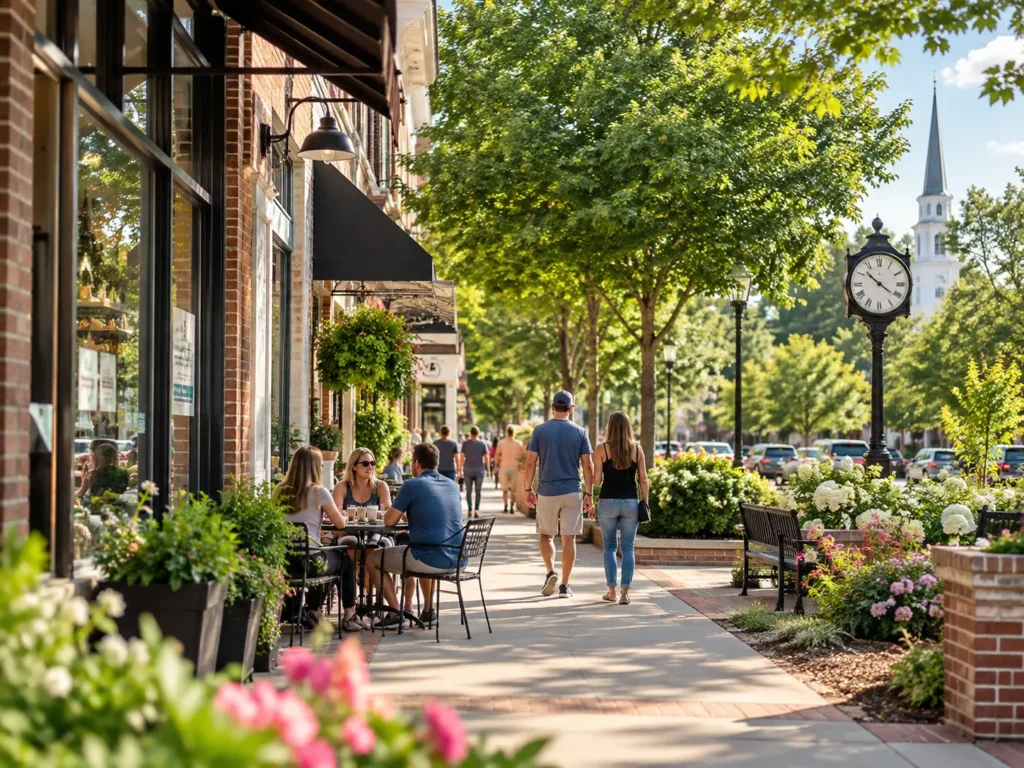
Wake Forest is one of those places that can make sense for a lot of different people without feeling like it is designed for only one kind of lifestyle.
You might be a first-time buyer looking for a neighborhood that still feels connected to Raleigh. You might be relocating from another state and want something quieter than the city without feeling isolated. You might be buying new construction, downsizing, working remotely, raising a family, or simply looking for a community where daily life feels a little easier.
What makes Wake Forest appealing is not one single attraction. It is the mix of walkable downtown character, newer growth, established neighborhoods, parks, greenways, local businesses, community events, and access toward Raleigh.
It feels like its own place.
Downtown Wake Forest Gives the Town a Real Center
One of the best things about Wake Forest is that it has an actual downtown rather than feeling like an endless stretch of subdivisions and shopping centers.
Downtown Wake Forest is compact, walkable, and filled with locally owned businesses. The town promotes the area for dining, shopping, art, entertainment, and community events.
A normal Saturday could easily include:
- Coffee at Wake Forest Coffee Company
- Browsing Page 158 Books
- Shopping at local boutiques downtown
- Lunch or dinner at Over the Falls
- Drinks or tapas at Bodega
- A rooftop stop at Unwined on White
- Games and food at Strike & Barrel
- A trip through the Wake Forest Farmers Market
The town’s own downtown food-and-drink guide highlights local dining, the farmers market, Bodega, Unwined on White, and Strike & Barrel as part of the downtown experience.
That kind of setup matters when you are choosing somewhere to live. It gives you places to actually use and return to rather than only a list of attractions you visit once.
Coffee Shops, Restaurants, and Places to Meet Friends
Wake Forest has grown enough that you do not have to head into Raleigh every time you want coffee or dinner.
Some popular local and area options include:
Coffee & Casual Stops
- Wake Forest Coffee Company
- Summer Moon Coffee
- Local downtown cafés and bakeries
Breakfast & Brunch
- Brigs at the Forest
- Local breakfast spots around downtown and the Heritage area
Lunch & Dinner
- Over the Falls
- Farm Table
- Bodega
- Restaurants throughout Gateway Commons and the Capital Boulevard corridor
Drinks & Social Spots
- Unwined on White
- Local breweries and taprooms
- Strike & Barrel for food, games, and a more social night out
What I like about this is the variety. Wake Forest gives residents enough local choices to have favorite places, while North Raleigh is still close enough for even more dining when you want it.
Shopping and Everyday Convenience
Wake Forest is large enough that routine errands generally do not require a trip into Raleigh.
Shopping areas buyers often use include:
- Gateway Commons
- Downtown Wake Forest
- Retail around Capital Boulevard
- Shopping and services along Rogers Road
- Grocery and neighborhood retail throughout town
Gateway Commons, for example, sits about a mile from downtown Wake Forest and includes Lowes Foods, Town & Country Hardware, restaurants, and other retailers.
This means day-to-day needs like groceries, home supplies, fitness, dining, and services can usually be handled locally.
Fitness Options Beyond the Neighborhood Gym
Wake Forest also has a growing mix of gyms, studios, and outdoor fitness options.
Depending on what you prefer, you can find:
- Larger fitness centers
- Smaller training gyms
- Pilates and barre studios
- Personal training
- Group fitness
- Outdoor walking and running routes
- Community recreation programs
And if you would rather skip the treadmill entirely, the greenways and parks make outdoor exercise easy to work into your routine.
Parks and Outdoor Space Are a Big Part of Life Here
Wake Forest manages 561 acres of parks, open space, natural land, and trails, including playgrounds, athletic fields, tennis courts, community centers, a dog park, and recreation facilities.
E. Carroll Joyner Park
This is one of the town’s standout public spaces.
Joyner Park covers 117 acres and includes:
- Three miles of paved trails
- Open meadows
- Restored farm buildings
- A pecan grove
- An amphitheater
- Gardens
- Community events and performances
It is the kind of place you can use for a short walk, a longer loop, a picnic, or a community event.
Greenways
Wake Forest currently has 15.5 miles of completed greenways, with the system continuing to expand.
Trails connect different parts of town and include routes around places such as:
- Joyner Park
- Dunn Creek
- Flaherty Park
- Kiwanis Park
Wake Forest Reservoir
For something quieter, the Wake Forest Reservoir offers:
- A 1.6-mile soft trail
- Fishing
- Paddle and electric-powered boating
- A boat launch
- Natural wooded scenery
It gives residents another outdoor option without needing to leave town.
There Is More Community Activity Than Buyers Sometimes Expect
Wake Forest has a strong calendar of local events and recreation, which helps the town feel active rather than purely residential.
Depending on the season, residents may find:
- Outdoor concerts
- Festivals
- Community movie nights
- Farmers markets
- Holiday events
- Family programs
- Recreation classes
- Youth sports
- Senior programs
- Cultural events
Joyner Park’s amphitheater is used for performances and community gatherings, while the town’s parks and recreation department operates programming throughout the year.
That makes Wake Forest attractive for people who want community activity nearby without needing to go downtown Raleigh every weekend.
Schools and Education
Most Wake Forest addresses in Wake County fall within the Wake County Public School System, but school assignment should always be checked using the exact property address.
Potential public schools serving parts of Wake Forest include:
Elementary
- Wake Forest Elementary
- Heritage Elementary
- Jones Dairy Elementary
- Richland Creek Elementary
Middle
- Wake Forest Middle
- Heritage Middle
High
- Wake Forest High
- Heritage High
Private and Charter Options
Buyers may also research options such as:
- Thales Academy of Wake Forest
- St. Catherine of Siena Catholic School
- Franklin Academy
- Wake Forest Charter Academy
- North Raleigh Christian Academy farther south
If school assignment matters to your move, I recommend verifying it before making an offer rather than relying on an old listing, neighborhood guide, or assumption.
Wake Forest Works for Different Stages of Life
One of Wake Forest’s biggest strengths is that it does not force buyers into one type of lifestyle.
First-Time Buyers
There are townhomes, smaller detached homes, and newer communities that can give buyers different ways into the market.
Growing Households
Larger homes, parks, recreation, neighborhood amenities, and access to schools make the area practical for buyers who need more space.
Remote Workers
Many homes offer enough square footage for a dedicated office without requiring a move into a very rural setting.
Relocating Buyers
Wake Forest gives people coming from out of state a community that is established enough to feel convenient but not as dense as Raleigh.
Empty Nesters and Downsizers
Townhomes, newer lower-maintenance options, and homes near amenities can work well for buyers who want less upkeep.
The point is not that Wake Forest is perfect for everyone. It is that there are enough different housing and lifestyle options here that a wide range of buyers can find something that feels right.
Housing Variety Is One of Wake Forest’s Biggest Advantages
Depending on where you look, Wake Forest can offer:
- Historic or older homes near downtown
- Established subdivisions
- Townhomes
- Newer planned communities
- New construction
- Luxury homes
- Golf-course communities
- Homes with larger lots
That means the search can change significantly even within the same town.
Someone who loves the established feel of Heritage may not be looking for the same thing as someone drawn to Holding Village, Traditions, or Hasentree.
And someone who wants to be close to downtown may prioritize something completely different again.
How Wake Forest Connects to Raleigh
Wake Forest is close enough to Raleigh that many residents commute or regularly travel south for work, healthcare, shopping, entertainment, or social activities.
That gives residents access to:
- North Raleigh
- Midtown and North Hills
- Downtown Raleigh
- RDU International Airport
- Research Triangle Park
- Major healthcare systems
- Universities and cultural attractions throughout the Triangle
But I always encourage buyers to think about the commute from the specific home, not simply from “Wake Forest.”
A home on the southern side of town can create a very different daily routine from one farther north or east.
Growth Is Part of the Wake Forest Story
Wake Forest is growing, and that is worth understanding before you move here.
Growth has brought:
- More restaurants
- More shopping
- New neighborhoods
- More housing options
- Additional services
- More traffic
- More development
Some buyers see that as a positive. Others are specifically looking for something quieter and may prefer Youngsville or Franklinton.
Neither reaction is wrong.
When I show homes in Wake Forest, I want buyers thinking about:
- Nearby undeveloped land
- Road access
- Current construction
- Future development
- How often they need to travel toward Raleigh
- Whether they prefer an established or growing area
That helps prevent surprises later.
The Neighborhood You Choose Changes the Experience
Living in Wake Forest can feel very different depending on where you buy.
Heritage
Good for buyers who want an established master-planned community with amenities and a strong neighborhood identity.
Holding Village
Appeals to buyers who like trails, parks, lake access, and a newer planned-community setting.
Traditions
Offers newer homes and a modern suburban feel.
Bowling Green
Can provide a more established neighborhood option at a different price point.
Hasentree
A luxury choice centered around golf, club amenities, and larger properties.
Downtown Wake Forest
Better suited to buyers who value character, local businesses, and proximity to the town center.
That variety is why I usually recommend spending time in several parts of Wake Forest before narrowing the search.
So, Is Wake Forest a Good Place to Live?
For many buyers, yes—but the better question is whether it matches your priorities.
Wake Forest tends to work well for people who want:
- A community with its own identity
- Access to Raleigh without living in the city
- A mix of established and newer neighborhoods
- Parks and outdoor recreation
- Local restaurants and coffee shops
- Everyday shopping close by
- Community events
- Different housing options as their needs change
The best way to know is to experience the area like a resident.
Drive through the neighborhoods. Walk downtown. Stop for coffee. Visit Joyner Park. Try the commute at the time you would actually make it. Look at homes in different parts of town and compare what your budget buys.
When I work with buyers, especially people relocating to North Carolina, that context is just as important as the house itself.
The goal is not simply to find a home you like.
It is to find a place where you can picture your actual day-to-day life happening.