
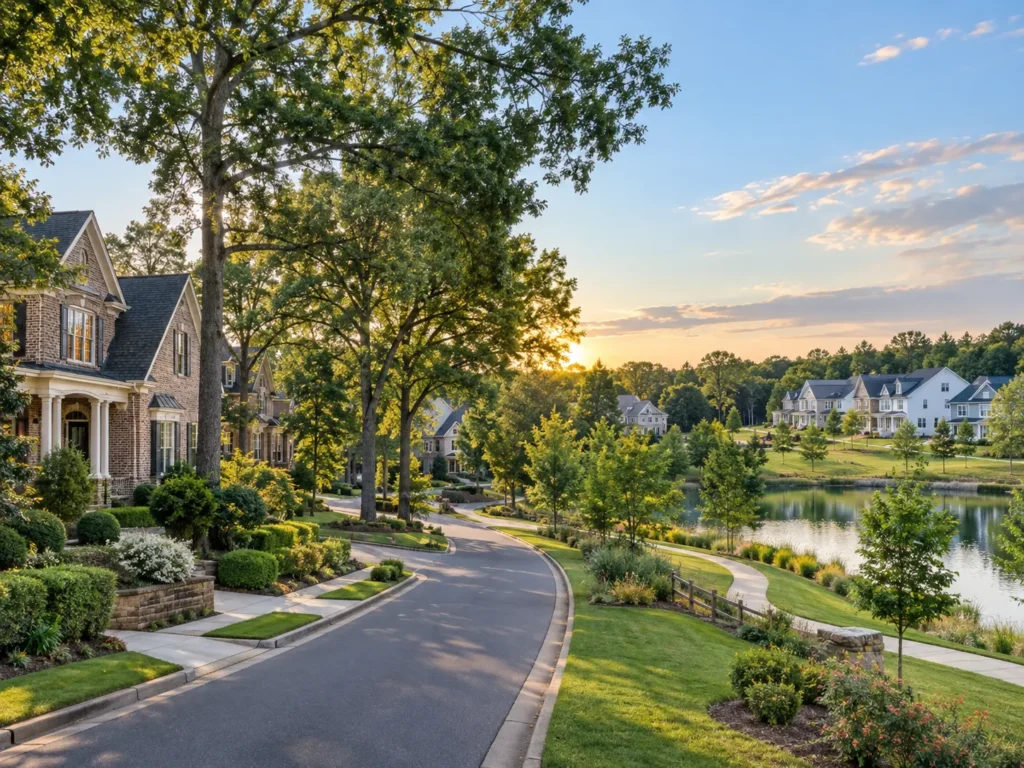
North Raleigh and Wake Forest are close enough that buyers often search both at the same time.
That makes sense. Both offer established neighborhoods, parks, shopping, restaurants, access to major roads, and a wide range of home styles. But the day-to-day experience can feel noticeably different.
North Raleigh is more connected to the city. Wake Forest feels more like its own town.
If you are deciding between the two, I would not focus only on which one has the better house for the money. I would look at how each location affects your commute, your weekends, your neighborhood options, and the kind of environment you want to come home to.
Quick Comparison: North Raleigh vs. Wake Forest
| Category | North Raleigh | Wake Forest |
|---|---|---|
| Overall feel | Established urban-suburban | Growing suburban town |
| Recent median sale price | About $499K | About $465K |
| Housing | Older homes, renovated properties, townhomes, luxury, some newer construction | Established homes, townhomes, large planned communities, significant new construction |
| Downtown | No single downtown; Midtown/North Hills acts as a major activity center | Historic, walkable downtown |
| Raleigh access | Generally closer | Farther north |
| Outdoor recreation | Lakes, parks, nature preserves, Falls Lake | Greenways, parks, Wake Forest Reservoir, Falls Lake |
| Best-known lifestyle areas | North Hills, Lafayette Village, North Ridge, Bedford, Wakefield | Downtown Wake Forest, Heritage, Holding Village, Traditions, Hasentree |
| General appeal | Convenience and city access | Community feel and housing variety |
Recent Redfin data through August 2026 showed a median sale price of about $499,000 in North Raleigh and about $465,000 in Wake Forest. Those figures are useful for context, but both areas include neighborhoods far above and below their overall median. (Redfin)
The Biggest Difference: City Convenience vs. Separate-Town Feel
The easiest way to understand the difference is this:
North Raleigh feels like part of Raleigh. Wake Forest feels like a separate community that happens to be close to Raleigh.
In North Raleigh, you are surrounded by established commercial corridors, neighborhoods, offices, restaurants, and shopping.
Wake Forest has its own downtown, town events, municipal parks, community identity, and local business scene.
Neither is inherently better. They simply create different routines.
North Raleigh may feel right if you want:
- Easier access to central Raleigh
- Established neighborhoods
- More restaurants and shopping close by
- Mature trees and older housing stock
- Convenient access to I-440 and I-540
- Midtown and North Hills nearby
Wake Forest may feel right if you want:
- A town with its own downtown
- More newer neighborhoods
- More new-construction choices
- Community events and local businesses
- A little more separation from Raleigh
- Easier access north toward Youngsville and Franklinton
What Does Your Budget Buy?
The overall numbers are closer than some buyers expect.
In August 2026, Realtor.com reported a North Raleigh median sold price around $497,000, while Wake Forest’s citywide median sold price was about $535,000 using its methodology. Redfin’s three-month figures put North Raleigh at about $499,000 and Wake Forest at about $465,000. Different platforms use different time periods and calculations, which is why I prefer looking at actual comparable homes instead of assuming one area is always cheaper. (Realtor)
More importantly, the type of home you get can differ.
In North Raleigh, your budget may go toward:
- Location closer to Raleigh
- Mature landscaping
- Established neighborhoods
- Renovated older homes
- Larger older lots
- Proximity to North Hills or major roads
In Wake Forest, your budget may go toward:
- Newer construction
- More recent floor plans
- Planned-community amenities
- Newer subdivisions
- Townhomes and detached homes in large developments
- More opportunities to compare resale with brand-new construction
A 2,500-square-foot house in North Raleigh and a 2,500-square-foot house in Wake Forest may therefore be very different purchases.
North Raleigh Has the Edge in Raleigh Convenience
If your daily life is centered in Raleigh, North Raleigh has an obvious geographic advantage.
Depending on the neighborhood, you may be closer to:
- Downtown Raleigh
- Midtown and North Hills
- Crabtree Valley
- Major medical facilities
- Raleigh employers
- I-440
- I-540
- RDU and RTP routes
That can matter a lot if you commute several days a week.
Wake Forest is still well connected. The Town of Wake Forest lists North Raleigh at roughly five minutes from the town boundary, Downtown Raleigh at about 35 minutes, and RTP at about 30 minutes under its general driving estimates. Actual travel time depends heavily on your exact address and traffic. (Town of Wake Forest, NC)
One thing I tell buyers
Do not compare “North Raleigh to Wake Forest” using a generic commute calculator.
Compare the actual homes.
A house in northern Wakefield and a house in southern Wake Forest may be surprisingly close together. Meanwhile, two North Raleigh homes can have very different access to the roads you need.
Restaurants, Coffee, and Going Out
Both areas give you plenty of places to spend time, but the experience is different.
North Raleigh
North Raleigh has a larger and more spread-out dining scene.
Popular places and districts include:
- North Hills
- Lafayette Village
- Jubala Coffee
- Sola Coffee Cafe
- Coquette Brasserie
- Rosewater Kitchen & Bar
- Bartaco
- The Cowfish
- Sassool
- Winston’s Grille
- Vinnie’s Steak House & Tavern
You generally have more choices within a shorter drive, especially if you live closer to Midtown.
Wake Forest
Wake Forest’s restaurant scene is smaller but has more of a local-town feel.
Places buyers may enjoy include:
- Wake Forest Coffee Company
- Over the Falls
- Bodega
- Unwined on White
- Farm Table
- Brigs at the Forest
- Summer Moon Coffee
- Strike & Barrel
Downtown Wake Forest concentrates several local businesses into an area you can walk rather than driving between shopping centers.
The lifestyle difference
If you like having a large number of restaurants and entertainment options around you, North Raleigh probably gives you more variety.
If you like the idea of recognizing downtown businesses and having a smaller local district to return to, Wake Forest may have more charm for you.
Shopping and Everyday Errands
Both areas are convenient for daily life.
North Raleigh Shopping
Residents may regularly use:
- North Hills
- Lafayette Village
- Crabtree Valley Mall
- Pleasant Valley Promenade
- Falls of Neuse Road
- Six Forks Road
- Creedmoor Road
- Strickland Road
Grocery options include:
- Wegmans
- Whole Foods Market
- Trader Joe’s
- Harris Teeter
- Publix
- The Fresh Market
- Target
Wake Forest Shopping
Wake Forest offers:
- Gateway Commons
- Downtown Wake Forest shops
- Retail along Capital Boulevard
- Rogers Road businesses
- Grocery stores throughout town
- Everyday medical and professional services
Wake Forest residents can generally handle daily errands locally, but North Raleigh offers a denser selection of retail.
Parks and Outdoor Recreation
This category is strong in both places.
North Raleigh
Popular outdoor destinations include:
- Shelley Lake Park
- Lake Lynn Park
- Durant Nature Preserve
- Falls Lake State Recreation Area
- Raleigh greenway connections
- Neighborhood recreation in communities like Bedford and Wakefield
These options are especially convenient if you want lakes, wooded trails, or access to Raleigh’s larger greenway system.
Wake Forest
Wake Forest offers:
- E. Carroll Joyner Park
- Wake Forest Reservoir
- More than 15 miles of completed greenways
- Flaherty Park
- Holding Park
- Community trails
- Nearby access to Falls Lake
Wake Forest manages hundreds of acres of parks, trails, open space, and recreational facilities. (Town of Wake Forest, NC)
Which one feels more outdoorsy?
That depends more on the specific neighborhood than the town name.
Someone living near Durant Nature Preserve may have better trail access than someone in a dense part of Wake Forest.
Someone in Holding Village or near Joyner Park may have outdoor recreation built more directly into daily life.
Neighborhoods Feel Different
This may be the most important comparison.
Popular North Raleigh Areas
North Raleigh buyers commonly consider:
- Bedford at Falls River
- Wakefield
- Falls River
- North Ridge
- Stonehenge
- North Hills
- Established neighborhoods around Falls of Neuse and Creedmoor Road
Many of these areas have mature trees and homes that have been around long enough for the neighborhood to feel settled.
Popular Wake Forest Communities
Wake Forest buyers may look at:
- Heritage
- Holding Village
- Traditions
- Bowling Green
- Hasentree
- Areas around downtown
- Numerous newer subdivisions
Wake Forest has a particularly strong mix of established subdivisions and ongoing new construction.
New Construction: Wake Forest Has More of It
If new construction is high on your list, Wake Forest will usually give you more options to compare.
That may include:
- Brand-new detached homes
- Townhomes
- Planned communities
- Later phases of existing developments
- Communities still adding amenities
North Raleigh does have new construction, but much of it takes the form of:
- Infill
- Tear-down/rebuild projects
- Smaller developments
- Luxury construction
- New homes mixed into established areas
That creates a very different buying process.
In Wake Forest, you may be comparing one builder community against another.
In North Raleigh, you may be comparing a new infill home against a renovated 30-year-old property on a mature lot.
Established Homes: North Raleigh Has More Depth
If you like mature neighborhoods, North Raleigh deserves a serious look.
Homes built decades ago may offer:
- Larger trees
- More established landscaping
- Different architecture
- Larger or more varied lots
- Neighborhoods with very little active construction
The tradeoff is maintenance.
With older homes, I pay close attention to:
- Roof age
- HVAC
- Windows
- Plumbing
- Electrical systems
- Crawl spaces
- Drainage
- Renovation quality
A newer Wake Forest home may reduce some of those concerns, but newer does not automatically mean better. Construction quality, lot, builder history, and neighborhood development still matter.
Schools: Both Are Primarily WCPSS, but Check the Address
Most North Raleigh and Wake Forest properties in Wake County are served by the Wake County Public School System.
Potential schools vary widely.
North Raleigh may include schools such as:
Elementary
- North Ridge Elementary
- Lynn Road Elementary
- Lead Mine Elementary
- Abbotts Creek Elementary
- Brassfield Elementary
Middle
- West Millbrook Middle
- East Millbrook Middle
- Wakefield Middle
High
- Sanderson High
- Millbrook High
- Wakefield High
Wake Forest may include:
Elementary
- Wake Forest Elementary
- Heritage Elementary
- Jones Dairy Elementary
- Richland Creek Elementary
Middle
- Wake Forest Middle
- Heritage Middle
High
- Wake Forest High
- Heritage High
Private and charter choices around the two areas include:
- Ravenscroft School
- St. David’s School
- North Raleigh Christian Academy
- Thales Academy of Wake Forest
- Franklin Academy
- St. Catherine of Siena Catholic School
- Wake Forest Charter Academy
The important part is that WCPSS assignments depend on the specific address. Never choose a property solely because a listing or neighborhood website says it is associated with a particular school.
Gyms and Fitness
North Raleigh generally offers more commercial fitness options.
You may find:
- O2 Fitness
- Life Time
- Orangetheory
- Burn Boot Camp
- Club Pilates
- Pure Barre
- F45
- YMCA facilities
- Smaller independent gyms
Wake Forest also has traditional gyms, boutique studios, Pilates, barre, personal training, neighborhood fitness centers, and plenty of outdoor recreation.
For many buyers, the difference comes down to whether they want fitness to be part of a larger commercial district or built into the neighborhood itself.
North Raleigh May Feel Busier
The convenience of North Raleigh comes with a tradeoff.
Major roads such as:
- Falls of Neuse Road
- Creedmoor Road
- Six Forks Road
- Capital Boulevard
can get busy.
Wake Forest has its own congestion issues, particularly as the town grows and along major routes connecting it to Raleigh.
Capital Boulevard between Raleigh and Wake Forest is also slated for a major long-term upgrade. Current plans call for converting portions between I-540 and Wake Forest into a six-lane controlled-access highway, with construction currently scheduled to begin in 2031. (Town of Wake Forest, NC)
For someone planning to stay in the area for many years, that is worth knowing.
Wake Forest Has More of a Community-Event Feel
Wake Forest’s municipal identity creates a different type of community experience.
Residents have access to events such as:
- Outdoor concerts
- Downtown festivals
- Farmers markets
- Holiday events
- Park programming
- Family recreation
- Local cultural events
North Raleigh certainly has events, especially around North Hills and Raleigh’s larger citywide calendar, but it does not function as one separate town.
That can make Wake Forest feel more intimate even though it is no longer a particularly small community.
So Which One Should You Look At?
I would start with your priorities rather than trying to decide which location is objectively better.
North Raleigh may deserve more of your attention if you want:
- Shorter access to central Raleigh
- More dining and shopping
- Mature neighborhoods
- Established homes
- Midtown and North Hills nearby
- More urban-suburban convenience
Wake Forest may deserve more attention if you want:
- A distinct town identity
- Historic downtown Wake Forest
- More new construction
- Large planned communities
- Parks and greenways
- Community events
- Easier access farther north
You May Not Need to Choose Before You Start Looking
This is one of those comparisons where I would rarely tell a buyer to eliminate one area immediately.
They are close enough that you can learn much more by seeing both.
Spend a morning looking at an established North Raleigh home near Stonehenge. Tour something newer in Bedford. Then drive into Wake Forest and compare homes in Heritage, Holding Village, or Traditions.
Stop at North Hills.
Walk downtown Wake Forest.
Drive your actual commute.
Compare the lot sizes, neighborhoods, HOA fees, home ages, and what the same budget buys.
I have spent more than 10 years helping buyers evaluate homes in Wake Forest and the surrounding Raleigh market, and this is exactly the kind of decision where seeing the differences firsthand is more useful than relying on a generic list of pros and cons.
You may discover that you strongly prefer one.
Or you may realize that the right house and neighborhood matter more than whether the mailing address says Raleigh or Wake Forest.